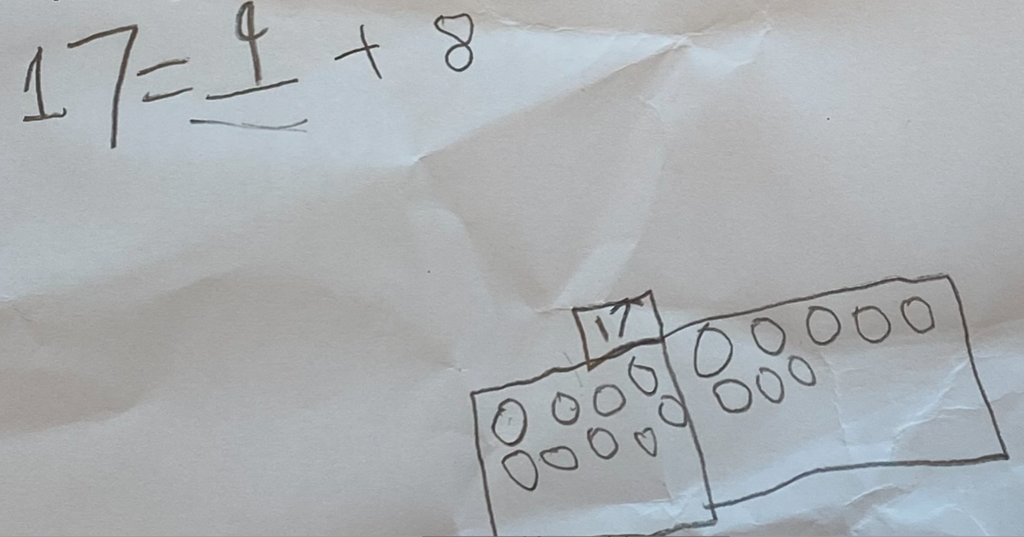
Turning now toward my students’ work, I will highlight three strategies my students used to solve the problem. Using these three strategies to plan a debriefing discussion, I will discuss how I would introduce these strategies and what questions or concepts I would like to highlight. For the discussion, I would start with Mason’s work as he reached the correct answer of nine blue cars using a part-part-whole mat. This provides a good opening strategy as my students have already learned about and used part-part-whole mats to solve problems. It gives an accessible and familiar entry point for all my students to comprehend the problem and the solution. Even more, I could continue to center and uplift Mason’s thinking by using questions to prompt a complete explanation from him or the other students (Battey et al., 2018, p. 435). For example, I could open up space for greater student discussion by asking can anyone explain what this student did? What in the problem told them they needed to figure out the number of blue cars Elijah needed to have 17 total cars? Why did they stop at 17? In this manner, I can use talk moves such as facilitating greater participation or having one student apply their reasoning to Mason’s. Thus, I can have my students drive the understanding toward the central mathematical concept that my students should find the unknown change – 9 – to answer to question of how many blue cars Elijah has (Ebby, Hulbert & Broadhead, 2021, p. 177).
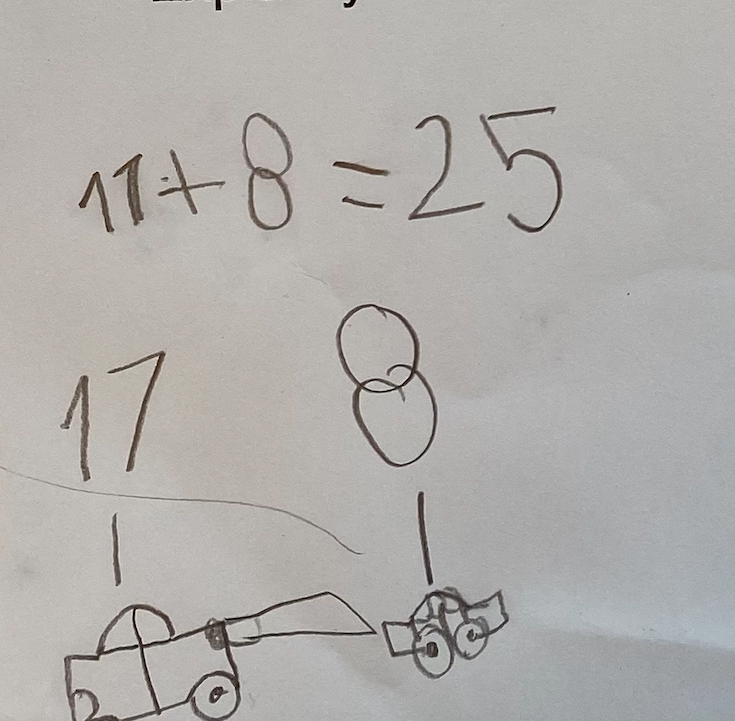
Building off my students’ beginning to understand that they were trying to find the change between 8 and 17, I would turn back to a common misconception present in many of my students’ work during the formative task. Throughout the semester, I noticed that my students could solve change unknown problems very easily during direct instruction. However, they struggled with these problems during independent practice, often adding the two known numbers together. Now, turning back to the formative task, Kaylene’s work shows this common misconception as she added 17 and 8 to arrive at the answer of 25. As many of my students used a similar strategy, it would be beneficial to address this misconception for Kaylene and the rest of the class. However, I also need to be very intentional with presenting this work as I still want to uphold and affirm the validity of her mathematical thinking (Battey et al., 2018, p. 437). To strike such a balance, I could ask: what question is this student answering? Is it the same or different from what the problem wanted you to figure out? Explain why you think it is the same/different. Using Kaylene’s solution to generate whole class discussion, I can affirm it as a critical site for developing my students’ understanding and position it as valuable.
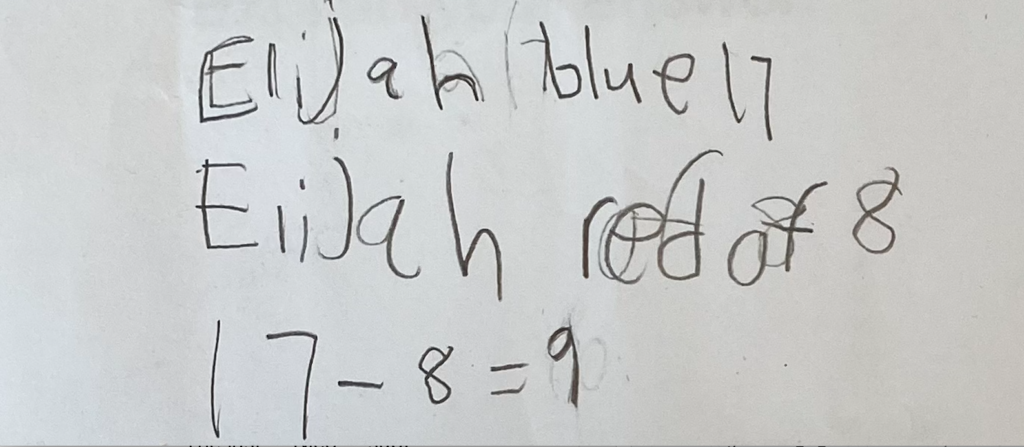
Finally, I would focus on Nico’s work for the discussion. Nico was the only student in my class who used subtraction to solve the problem, knowing that he could subtract 8 from 17 to get the answer of 9. Building on my students’ emerging understanding of the problem and what it is asking after discussing both Mason and Kaylene’s work, I could utilize Nico’s to further extend my students’ understanding by focusing on developing their flexibility with operations (Ebby, Hulbert & Fletcher, 2019, p. 352). More simply, I could begin to advance my students’ understanding that they can use both addition and subtraction to help them solve this problem. To think about how I could drive toward this understanding, I could ask my students: how could we show this student’s way of figuring out the problem by drawing a picture? What is alike and what is different about this way of solving the problem from how the other two students solved it? Why? and how could what you have learned about related facts help you solve this problem? Most importantly, these questions that leverage the other students’ solutions and my students’ background knowledge of related facts provides a space to validate all the solutions by putting them in conversation with each other.
