
Lesson Plan and the Task
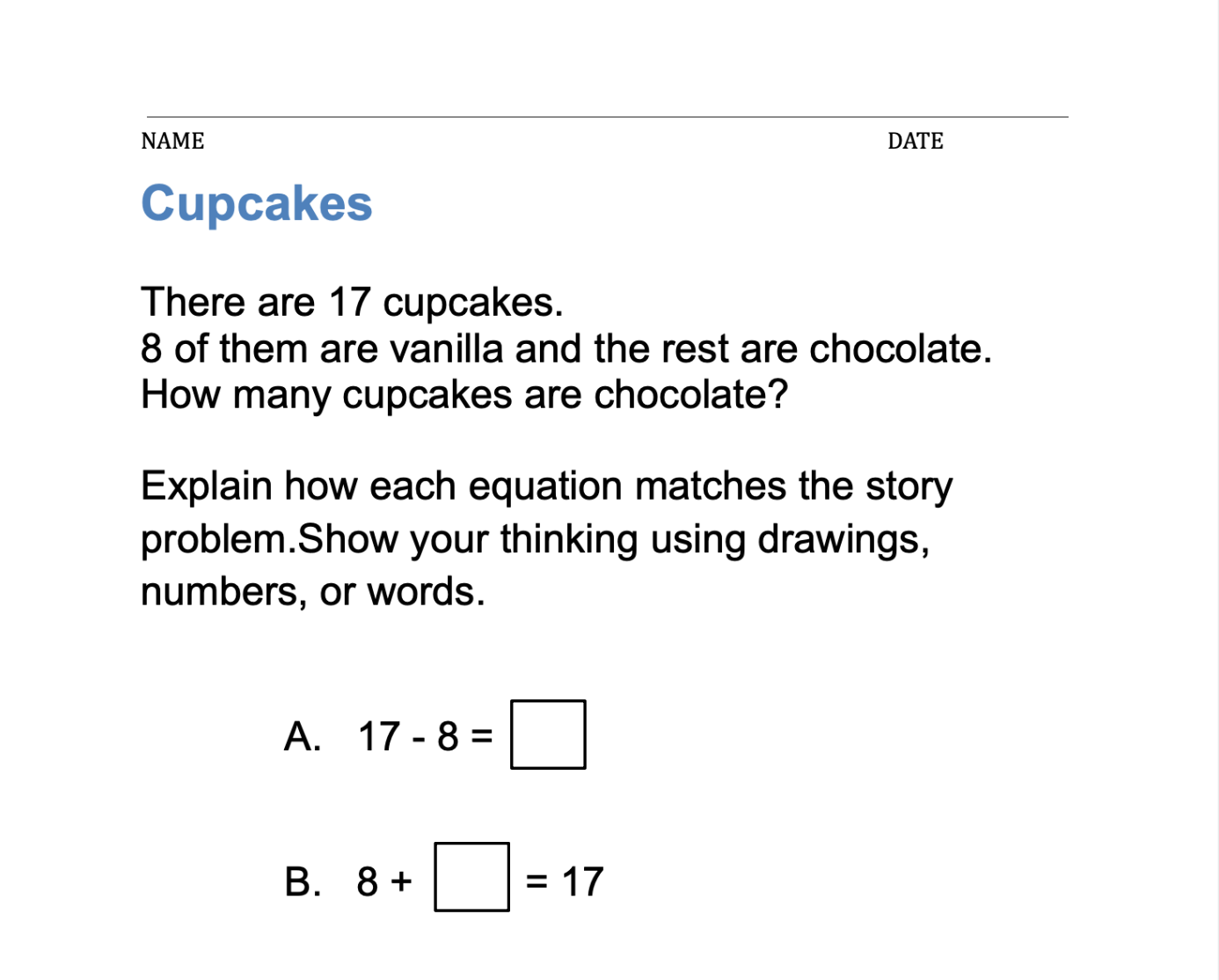
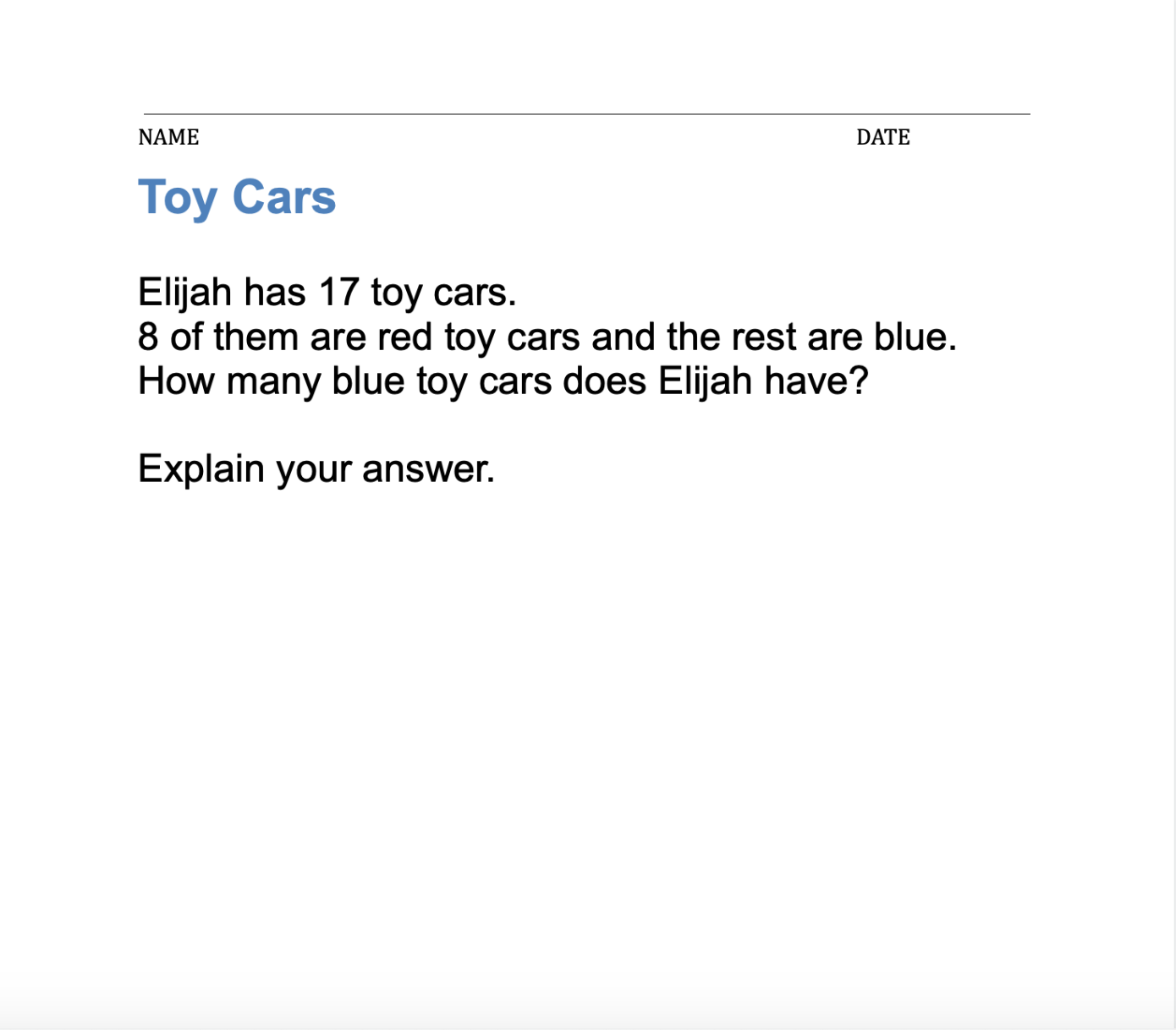
While planning for the formative task, I tried to carefully select the task and how I would launch and frame it. As I have already described, I chose a formative task from the Philadelphia School District Curriculum. However, I changed the problem to better activate my students’ prior knowledge and affirm their lived experiences. As Jackson et al. (2012) argue, teachers can “connect the task scenario to a person, place, or event that might be familiar or of interest to the students” (p. 27). Aligning with this idea, I chose to change the problem to center on a student in my class named Elijah. Elijah struggles in class to sit still and is often reprimanded by both me and my CM. To center him positively in the classroom and align with his intense interest in toy cars,
I chose that as the focus of my problem. Likewise, by changing the formative task, I could not only focus on one of my student’s interests but also frame the problem within a context familiar to all my students.
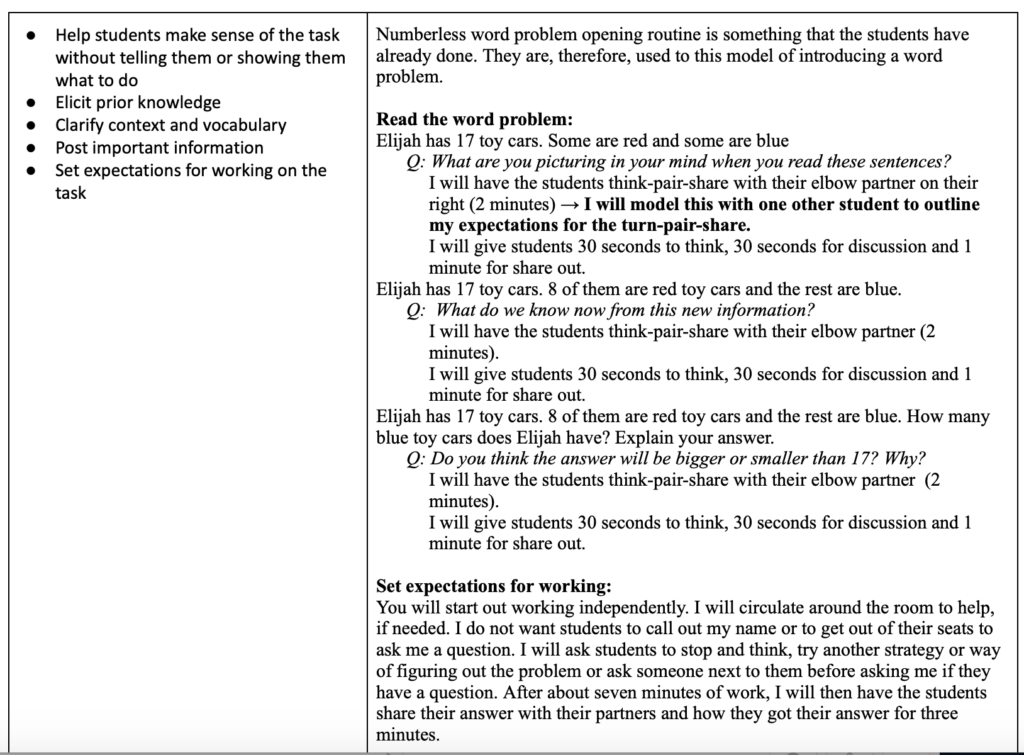
Besides my intentionality in choosing this task, I also tried to be more intentional in launching it. I have multiple ELL students in my class who are just developing their understanding of academic English. To provide them with a better entry point into the task, the main strategy I used was reading the problem three times and adding new information after each reading. Paralleling the KFA process (know, find and answer), this strategy helps to create a space where my students can deepen their understanding of the problem’s language and what it is asking them to solve (Ramirez & Tapetillo, 2017, p. 74). In this manner, I can help my ELL students develop their English language skills and give each student the time to understand the context of the problem.
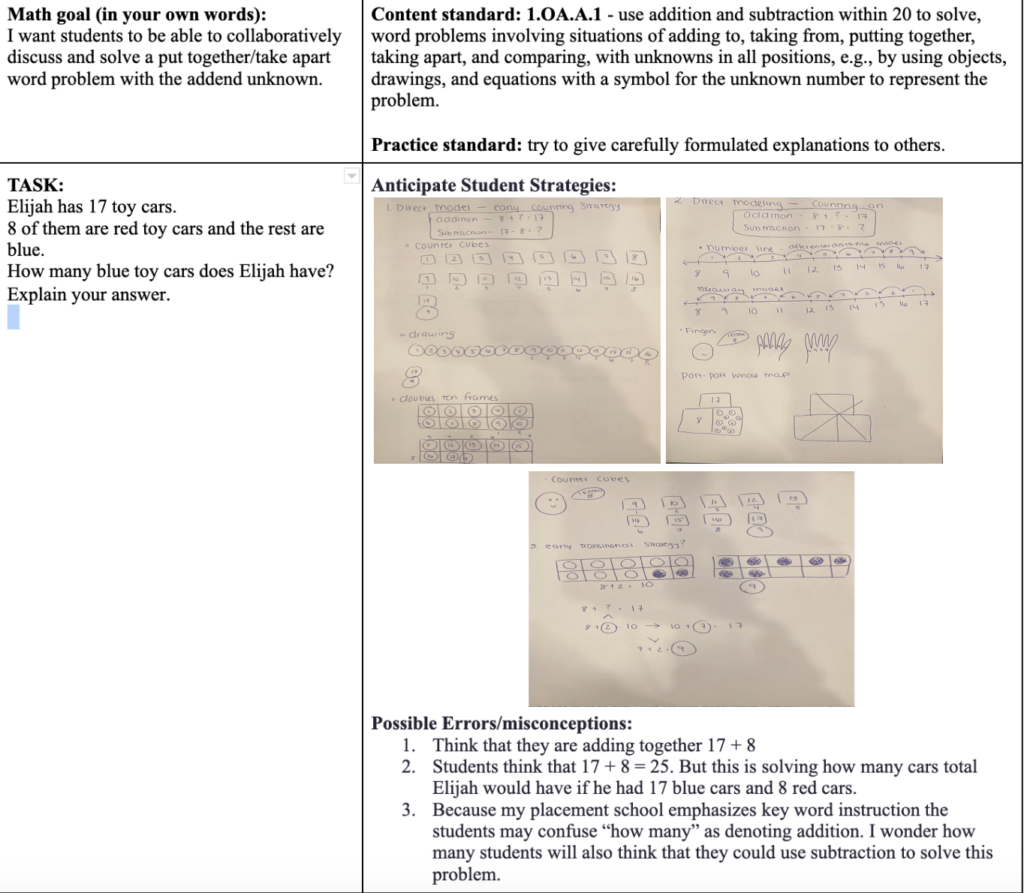
Finally, I also want to touch now on my efforts to anticipate my students’ strategies and any of their possible misconceptions. Using observations, I made of my students learning to help guide my instruction and planning of the formative task, I anticipated that my students might struggle with change unknown problems (Ebby, Hulbert & Fletcher, 2019, p. 347). I noticed that my students could understand and solve change unknown problems easily when guided by my CM and me. However, they often struggled when practicing these problems independently and continued adding the two known numbers. In other words, they might set up the problem as 8 + 17 = 25 instead of 8 + _ = 17. Keeping in mind this common student misconception, I intentionally tried to plan a worthwhile task where my students could have the scaffolding needed to agentively engage and explore the problem to more deeply understand a concept they struggle with – change unknown problems.
